Can Qataris buy property in Oman?
Yes, and with almost the same freedom as an Omani. In Qatar, foreigners are kept to a short list of zones such as The Pearl and West Bay. Oman treats a Qatari citizen very differently: Royal Decree 21/2004 lets nationals of the Gulf Cooperation Council states, and companies wholly owned by them, own and lease built-up property and land for residence and investment. That means a family villa in Shatti Al Qurum, a plot in Seeb or a house in Salalah, as well as anything inside the tourism complexes.
Oman's government portal sets out what a Qatari buyer needs to know. You must be over 21; a younger buyer holds the title deed jointly with a parent. You may hold more than one residential plot. A vacant plot cannot be sold or invested within four years of purchase until at least one building stands on it, and the property must not be under seizure or mortgage. The application goes through the Amlak platform of the Ministry of Housing and Urban Planning: a OMR 5 fee, identity documents, and about 10 days to process.
GCC citizens as a group took 1,252 title deeds in Oman in 2025 and 824 in the first nine months of 2026. The ministry does not publish a Qatari breakdown.
Qatari passport or Qatar residence permit: two sets of rights
The GCC rights follow the passport, not the address. An Indian engineer, a British banker or an Egyptian doctor living in Doha buys in Oman as a foreigner. For them the map shrinks to the Integrated Tourism Complexes such as Al Mouj, Muscat Bay and Jebel Sifah, and the other areas the ministry designates for foreign ownership. The full picture is in our foreign ownership guide.
One of those designated areas is Sultan Haitham City, where foreign buyers can purchase at Sarooj Oasis.
Residence is where a Qatar-based expatriate gains most. A completed home in a tourism complex worth OMR 200,000 or more, about QAR 1.89 million, with its title deed, qualifies for Oman's renewable 10-year Golden Residency, covering first-degree relatives. Owning any home in a complex brings a two-year owner's residence visa. Qatari citizens need neither, as our guide to residency in Oman explains.
From Doha to Muscat and Salalah
Qatari citizens need no visa, and since 30 March 2022 GCC nationals can cross into Oman on their national ID card, using the GCC counters at Muscat airport. Expatriates in Qatar either enter visa-free on their own passport, if Oman's Ministry of Foreign Affairs lists their nationality, or apply for the GCC resident visa on the Royal Oman Police eVisa for OMR 5.
Qatar Airways and Oman Air fly Doha to Muscat in about 1 hour 40 minutes, many times a day, so a Thursday evening flight and a Saturday return is enough for a round of viewings. Qatar Airways also flies Doha to Salalah non-stop all year, in about 2 hours 15 minutes, which matters to families who spend the khareef there.
Paying in Qatari riyals
There is no currency risk between Doha and Muscat. The Qatar Central Bank holds the riyal at QAR 3.64 to the US dollar, and the Omani rial has been tied to the dollar since 1986 at about USD 2.60, so OMR 1 works out at about QAR 9.47. A one-bedroom flat at OMR 120,000 is roughly QAR 1.14 million; an OMR 500,000 villa at AIDA, QAR 4.73 million. Neither figure moves with exchange rates.
Off-plan money goes into the escrow account that Royal Decree 79/2025 requires for each project and each phase, so check that the account in your reservation form matches the one in the sale contract. Omani banks lend to foreign buyers only on approved projects in the complexes; see mortgages for foreigners.
Tax: Qatar's territorial system and the 2023 treaty
PwC's summary of Qatar, last reviewed in September 2026, calls the system territorial: an individual is taxed only on qualifying income from sources in Qatar, and salaries, wages and allowances are not taxed at all. Rent from a flat in Muscat is not Qatar-source income.
Unlike Saudi Arabia and the UAE, Qatar also has a tax treaty with Oman. The Oman Tax Authority lists it as signed on 22 November 2021, ratified on 19 January 2022 and in effect from 1 January 2023. It becomes relevant from 1 January 2028, when Royal Decree 56/2025 brings in a 5% Omani tax on net income above OMR 42,000 a year, rent and property sales included. A family letting one or two homes in Oman will usually earn far less than that.
What it costs to buy, in riyals
Oman charges no annual property tax. At purchase you pay a 3% registration fee to the Ministry of Housing, usually borne by the buyer, plus 5% VAT if the home is new; resales carry no VAT. On a new OMR 200,000 villa that comes to OMR 16,037 with the fixed charges, or about QAR 152,000. The costs and taxes guide has the full list.
The price and the sale
How you pay
Your own costs
Total cost of buying
OMR 16,037
An estimate: 8% of the agreed price, paid on top of it.
- Registration fee3% of the value, paid to the Ministry of Housing and Urban Planning. Usually paid by the buyer; check your contract
- OMR 6,000
- Forms and title deedNon-Omani ownership application OMR 25, sale contract form OMR 2, title deed OMR 10
- OMR 37
- VAT on a new home5% on the first sale of a new home, added to the developer's price. Check whether your price list includes it
- OMR 10,000
- Price plus costs
- OMR 216,037
In short
Plan for OMR 216,037 in all: the price, plus 8% in buying costs.
After you buy
Oman has no annual property tax and no stamp duty. If you let the home, the lease is registered at 3% of the rent, paid by the landlord. From 1 January 2028 individuals pay 5% income tax on net income above OMR 42,000 a year, rent and gains on property included.
Rates checked on 16 November 2026 against the Ministry of Housing and Urban Planning's fee schedule (Ministerial Decision 570/2025). Developers do not charge resale fees: the Real Estate Regulation Law bars them. An estimate, not a quotation: property costs and taxes in Oman.
Sources for these figures
- Ministerial Decision 570/2025, schedule of real estate registration fees, Annex 7 (in force 27 January 2025), qanoon.om
- Ministerial Decision 36/2026 amending the fee schedule (in force 27 April 2026), qanoon.om
- PwC Worldwide Tax Summaries, Oman: other taxes (transfer fee, VAT, no property tax, no stamp duty), reviewed 7 July 2026
- Deloitte, Oman Tax Authority issues VAT guide for the real estate sector, 30 September 2021
- Oman Observer, register lease contracts to avoid fines (lease fee cut to 3%), 6 February 2021
- Royal Decree 56/2025, Personal Income Tax Law (from 1 January 2028), qanoon.om
- Royal Decree 79/2025, Real Estate Regulation Law (escrow per project and phase; no resale fees), qanoon.om
Talk it through
An adviser can confirm whether a developer's price includes VAT and send the current price list with the costs worked out on each home.
Send me this breakdown
Your figures by email, and an adviser to check them against the contract and price list of a real development.
Email me the breakdown
Where Qatari buyers look in Oman
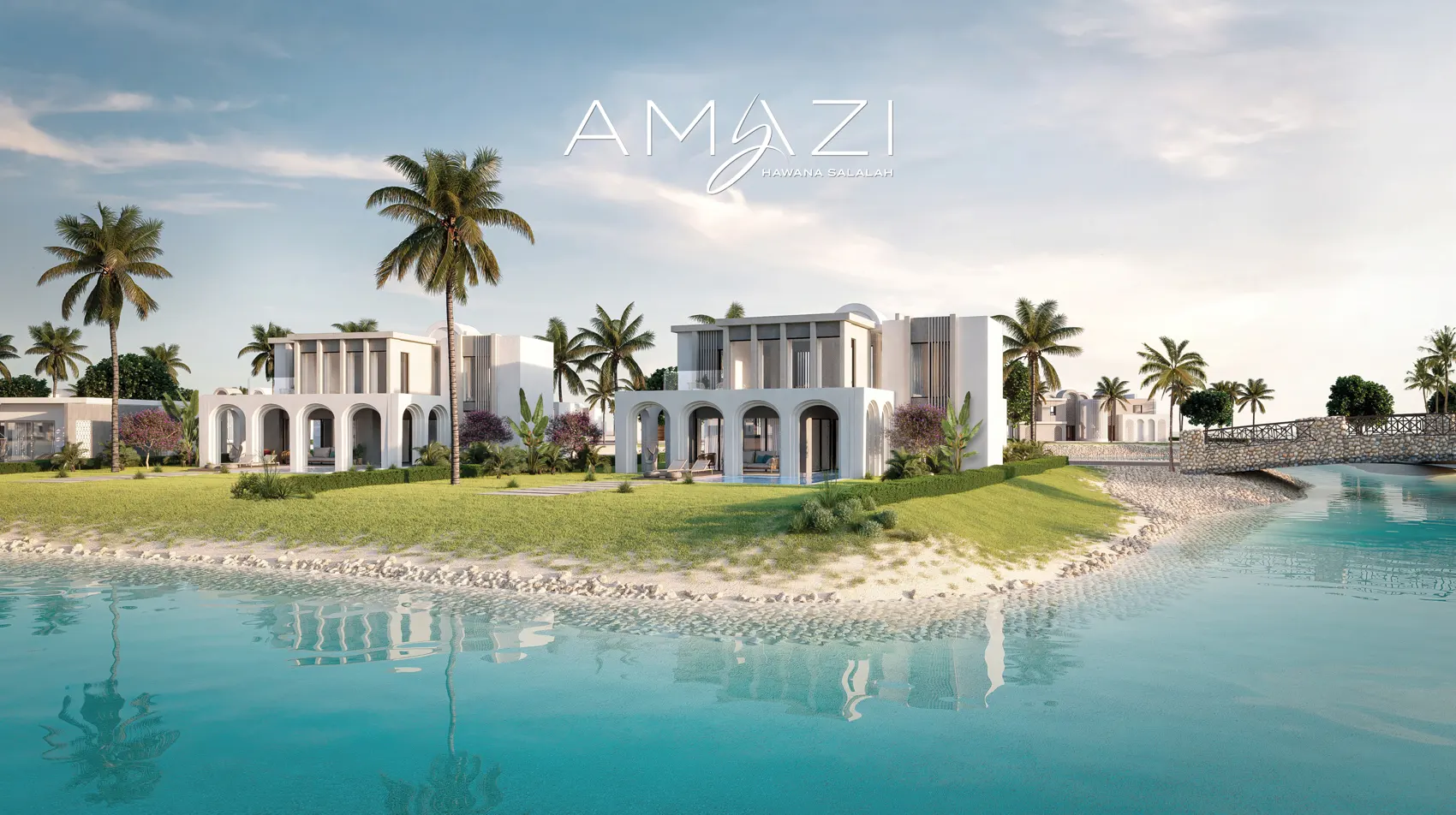
Two kinds of buyer come from Doha. Qatari families tend to buy for the khareef and the cooler months, and often want a standalone villa with space for the extended family. Because the GCC rules apply, they are not limited to resort developments: ordinary residential neighbourhoods in Salalah are open to them. For a home that can be let when the family is away, Hawana Salalah has lagoon villas at Hawana Islands from OMR 103,542 and chalets at Lubana Island from OMR 89,914.
In Muscat, buyers with larger budgets look at the beachfront Fendi Casa villas at AIDA, from OMR 1,505,700, or at Muscat Bay. Sarooj Oasis in Sultan Haitham City, from OMR 65,000, suits a first purchase in the capital's new city. Expatriates in Doha who want residence usually choose Al Mouj, where ALMAR Residences starts at OMR 101,853, and plan a later move up to a completed home above the OMR 200,000 line.
Ties between Qatar and Oman
Qatari money already knows the Sultanate. At an Oman and Qatar investment forum in Muscat in January 2025, Qatari investment in Oman was put at about RO 2 billion, or QAR 19 billion, across banking, energy, hospitality, tourism, logistics and real estate. Qatar's chamber of commerce put trade between the two countries at about QAR 6.2 billion in 2024.
Three checks before you sign
- Citizens: confirm the land rules for the plot, especially the four-year limit on selling vacant land.
- Residents of Qatar: check the development is inside a tourism complex or designated area, and whether it will be complete and titled if you want Golden Residency.
- Everyone: ask for the escrow account details in writing, and remember that prices and rents can fall as well as rise.