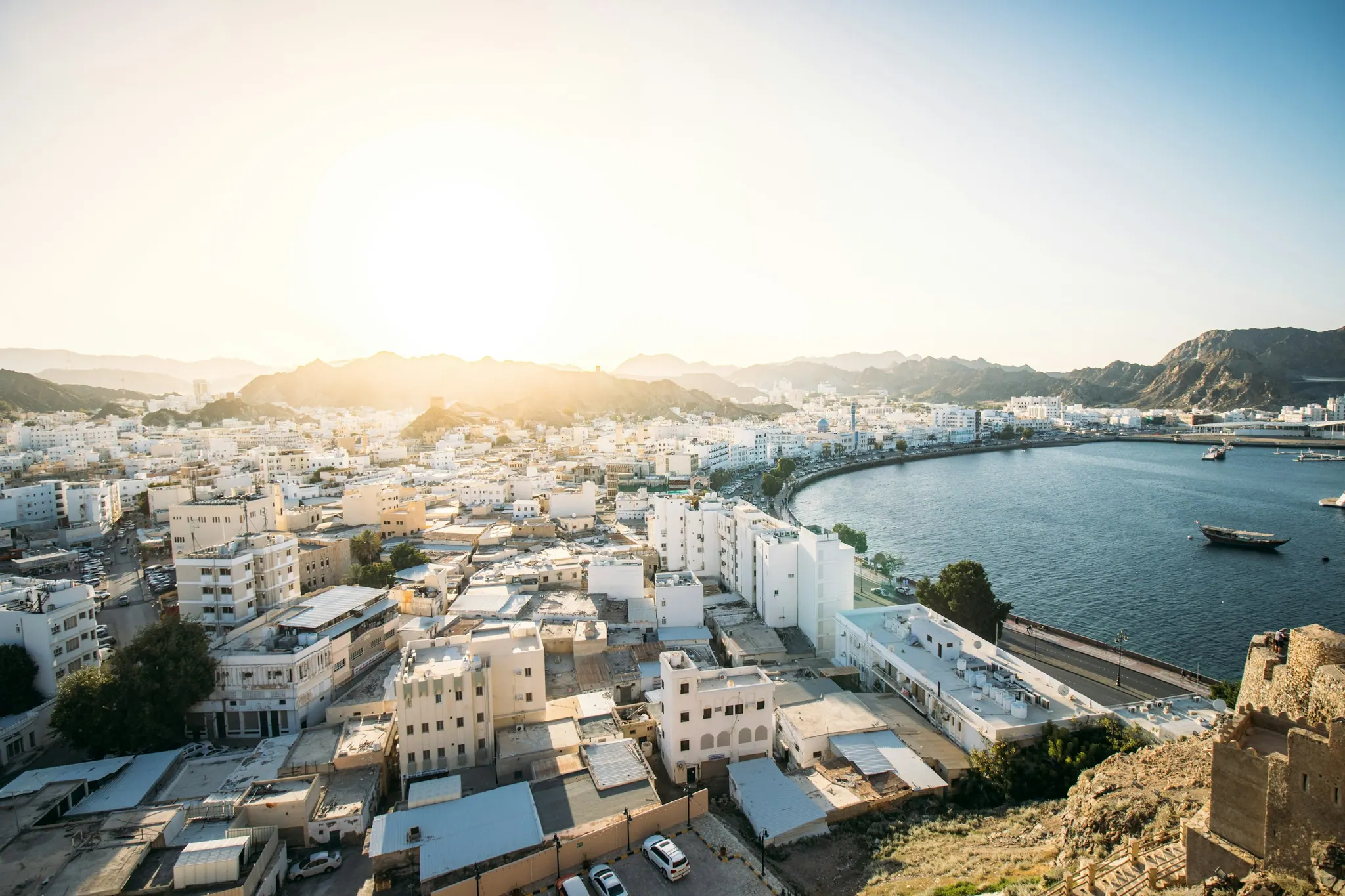
You can buy property in Oman as a foreigner, in the areas the government opens to you. Inside a licensed Integrated Tourism Complex (ITC) such as Al Mouj Muscat, Muscat Bay or Jebel Sifah, a buyer of any nationality owns the home freehold, registered in their own name with the Ministry of Housing and Urban Planning. Buying takes four moves: reserve, sign the sale and purchase agreement, pay, and register the sale for a 3% fee, with 5% VAT on top for a new home.
This guide is the full buying process for a first-time buyer in Oman: where you can own, each step and who does it, the documents, every cost worked in rials, buying from abroad, mortgages, residency, land and building, and buying through a company. The fees themselves are set out line by line in our guide to property costs and taxes in Oman.
Can foreigners buy property in Oman?
Yes, in designated areas. Royal Decree 12/2006 lets non-Omani individuals and companies own land or units inside licensed Integrated Tourism Complexes, for residence or investment (Article 1). In June 2026 the Ministry of Housing and Urban Planning said foreign ownership "has not been opened to all areas of the Sultanate" and named the designated areas: the ITCs; the future cities of Sultan Haitham City, Al Thuraya City and Al Jabal Al Aali; and integrated residential neighbourhoods such as Surouh (Gulf News, 28 June 2026). There is no minimum price for an ITC purchase. Our guide to foreign ownership in Oman covers every rule in depth.
Freehold in an Integrated Tourism Complex
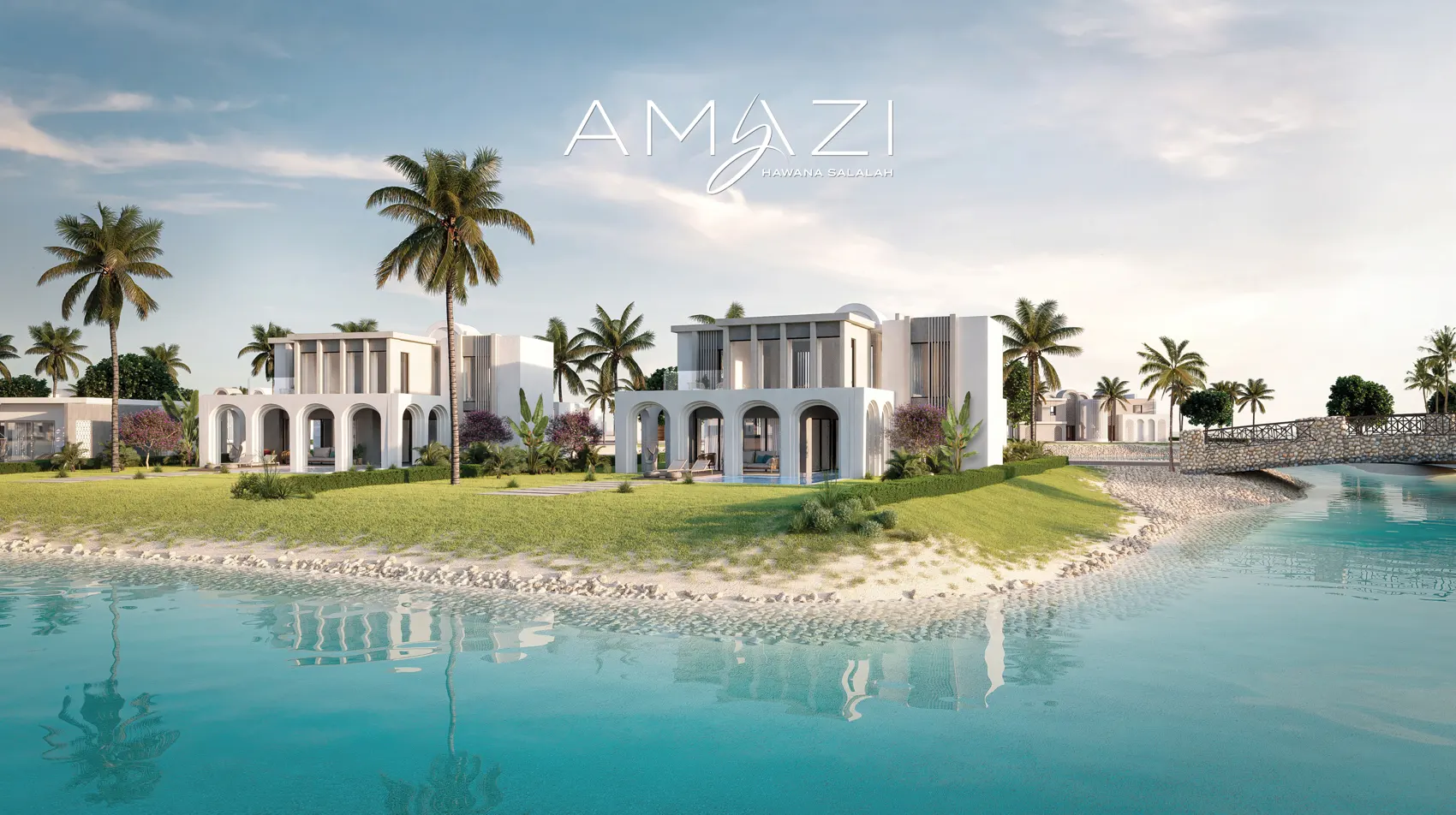
Oman had 19 valid ITC licences in July 2023 (Oman News Agency), so around 20 licensed complexes. Those that independent sources name as ITCs include Al Mouj Muscat, Muscat Bay, Barr Al Jissah and Saraya Bandar Jissah, Jebel Sifah, Hawana Salalah and Muscat Hills. Al Mouj's own eligibility page says non-Omanis "can enjoy freehold ownership" there. At AIDA, Dar Global says foreign buyers can own freehold, describing the community as an ITC open to all nationalities. The Sustainable City Yiti sells to buyers of every nationality, and the title is confirmed home by home. The owner of a built unit in an ITC may be granted residence for himself and his first-degree relatives (Article 8). See our guide to Integrated Tourism Complexes.
Usufruct flats outside the ITCs
Since October 2020, under Ministerial Decision 357/2020, resident expatriates have been able to buy a usufruct right in approved multi-storey buildings: a right to use the flat for up to 50 years, renewable to a maximum of 99, not outright ownership. The 2020 rules require the buyer to be 23 or over and resident in Oman for at least two years, set a minimum price of OMR 45,000 in Muscat and OMR 35,000 elsewhere, limit foreigners to 40% of a building's units, and bar resale or letting for four years. The first areas were in Muscat: Bausher, Al Amerat and Seeb, including Al Khuwair (2), Ghala Heights, Wattayah, Madinat Al Nahdah and Al Khoud. No residence visa comes with a usufruct flat. These are the 2020 rules; confirm they still apply to the building before you reserve. Registering a usufruct contract costs a flat OMR 25 (MD 570/2025). See usufruct.
Where foreigners cannot buy
Outside an ITC, Royal Decree 29/2018 closes the governorates of Musandam, Buraimi, Dhahirah and Al Wusta, Dhofar except Salalah, the wilayats of Liwa, Shinas and Masirah, Jebel Akhdar, Jebel Shams and other strategic mountains, all islands, land near royal palaces and military sites, archaeological sites and agricultural land anywhere in Oman. Inside a licensed ITC in those places, the ITC rules apply.
GCC nationals and Golden Residency holders
Citizens of the Gulf Cooperation Council states buy under their own rules (Royal Decree 21/2004): they may own built property and land for residence and investment, must be over 21, may own more than one residential plot, and must build on land within four years before selling it (gov.om, July 2026). Holders of the 10-year Golden Residency gain the right to own one property outside the ITCs (Oman Observer, 31 August 2025).
Which buyer are you?
The reason you are buying decides where you look first.
| You are | What matters | Where buyers like you look |
|---|---|---|
| A resident expatriate buying a home to live in | Commute, schools, resale | Usufruct flats in Seeb, Bausher and Al Khuwair; family homes at Al Mouj |
| An investor buying to let | Net yield, tenant demand, fees | Apartments at Al Mouj, where Savills put average rents at OMR 664 a month for apartments in Q2 2026 |
| A buyer of a long-term family asset | Privacy, views, scarcity | Villas at Muscat Bay and AIDA |
| A retiree or second-home buyer | Community, climate, ease | Resort homes at Jebel Sifah and Hawana Salalah |
| A first buyer on a tighter budget | Price, a payment plan | New homes in Sultan Haitham City, from OMR 43,050 at Wadi Zaha |
Branded homes are a market of their own in Muscat: Trump International Hotel and Marriott Residences at AIDA, Nikki Beach Residences at The Arc in Yiti and Vistal by Victoria Swarovski at Al Mouj. Our branded residences page compares them.
How to buy property in Oman: the process step by step
- Choose the home and check that you can own it. Confirm the community is an ITC or another designated area, and ask in writing which title you will receive: freehold or usufruct. For a home in Sultan Haitham City or Surouh, ask the developer to confirm the title type before you pay anything.
- Reserve. You sign a reservation form and pay a reservation amount set by the developer, not by law (at Vistal it is OMR 5,000). The developer checks your identity and the source of your funds.
- Do your due diligence. For a new home, ask for the developer's licence and the project's escrow account in writing: the Real Estate Regulation Law (Royal Decree 79/2025) requires a separate escrow account for each project and each phase. For a resale, check the seller's title deed with the ministry and ask for a letter showing service charges are paid. Have a lawyer independent of the seller read the contract.
- Sign the sale and purchase agreement (SPA). The SPA fixes the price, the payment schedule, the specification, the completion date and what happens if it is missed. Read the clause on reselling before completion and the one on VAT.
- Pay. Pay by bank transfer to the account the contract names, never to an individual. An off-plan home is paid in stages into the escrow account (see buying off-plan in Oman); a resale is paid in full at transfer.
- Register the sale with the Ministry of Housing and Urban Planning. The ministry charges 3% of the value, the OMR 25 non-Omani ownership application form, the OMR 2 sale contract form and OMR 10 for the title deed. On a new development, the developer handles the registration with the ministry; on a resale, the buyer and seller, or their lawyers, file it together.
- Receive the title deed. The Mulkiya is issued in your name. On an off-plan home this follows completion and handover.
- Take handover and apply for residency. Inspect the home against the SPA before you accept it (snagging), connect the utilities and, if the home qualifies, apply for residency (below).
Outside the ITCs, the law bars developers and owners' associations from charging for a resale (Royal Decree 79/2025, Article 19) and shares service charges between owners by unit area (Article 38). Inside an ITC, the community's own rules and development agreement govern any resale fee and how service charges are shared, so ask for them before you reserve.
Documents you need to buy a house in Oman
- Your passport, valid well beyond the purchase date, and a photograph.
- Proof of address and proof of the source of funds, which the developer and your bank ask for.
- The reservation form and the signed SPA.
- The non-Omani ownership application, filed with the ministry.
- For a resale: the seller's title deed and proof that the service charge is settled.
- For a buyer who will not attend: a power of attorney, notarised and attested for use in Oman.
- For a company buyer: its commercial registration and the board resolution to buy.
Costs of buying property in Oman, worked in rials
| Cost | Rate | Who pays | Source |
|---|---|---|---|
| Sale registration fee | 3% of the value, every nationality | Usually the buyer; check your contract | MD 570/2025, Annex 7 |
| VAT | 5% on the first sale of a new home; resales exempt | The buyer, in the price or on top | Tax Authority VAT guide |
| Fixed charges | OMR 37 (OMR 25 application, OMR 2 contract form, OMR 10 title deed) | The buyer | MD 570/2025, Annexes 11 and 13 |
| Mortgage registration | 0.5% of the loan | The borrower | MD 570/2025 |
| Agent's fee | Agreed in the contract; on new developments the developer usually pays the agent | As agreed | |
| Legal fees | By quote | You |
The press often reports that Omanis pay 1% and foreigners 3%. The schedule in force has one 3% rate for all sales; its 1% rows cover transfers into a company and purchases by investment funds. Developers' price lists may or may not include VAT: ALMAR and Vistal at Al Mouj, for example, quote prices before 5% VAT.
| Purchase | Registration 3% | VAT 5% | Fixed | Total before legal and bank fees |
|---|---|---|---|---|
| New one-bedroom at ALMAR Residences, Al Mouj, OMR 101,853 | OMR 3,056 | OMR 5,093 | OMR 37 | OMR 8,186 (8.0%) |
| New home, OMR 200,000 | OMR 6,000 | OMR 10,000 | OMR 37 | OMR 16,037 (8.0%) |
| Resale home, OMR 200,000 | OMR 6,000 | none | OMR 37 | OMR 6,037 (3.0%) |
| New villa, OMR 500,000 | OMR 15,000 | OMR 25,000 | OMR 37 | OMR 40,037 (8.0%) |
| Resale villa, OMR 500,000 | OMR 15,000 | none | OMR 37 | OMR 15,037 (3.0%) |
If you borrow OMR 140,000 against the OMR 200,000 home, add OMR 700 to register the mortgage. Work your own figures with the buying cost calculator.
The price and the sale
How you pay
Your own costs
Total cost of buying
OMR 16,037
An estimate: 8% of the agreed price, paid on top of it.
- Registration fee3% of the value, paid to the Ministry of Housing and Urban Planning. Usually paid by the buyer; check your contract
- OMR 6,000
- Forms and title deedNon-Omani ownership application OMR 25, sale contract form OMR 2, title deed OMR 10
- OMR 37
- VAT on a new home5% on the first sale of a new home, added to the developer's price. Check whether your price list includes it
- OMR 10,000
- Price plus costs
- OMR 216,037
In short
Plan for OMR 216,037 in all: the price, plus 8% in buying costs.
After you buy
Oman has no annual property tax and no stamp duty. If you let the home, the lease is registered at 3% of the rent, paid by the landlord. From 1 January 2028 individuals pay 5% income tax on net income above OMR 42,000 a year, rent and gains on property included.
Rates checked on 16 November 2026 against the Ministry of Housing and Urban Planning's fee schedule (Ministerial Decision 570/2025). Developers do not charge resale fees: the Real Estate Regulation Law bars them. An estimate, not a quotation: property costs and taxes in Oman.
Sources for these figures
- Ministerial Decision 570/2025, schedule of real estate registration fees, Annex 7 (in force 27 January 2025), qanoon.om
- Ministerial Decision 36/2026 amending the fee schedule (in force 27 April 2026), qanoon.om
- PwC Worldwide Tax Summaries, Oman: other taxes (transfer fee, VAT, no property tax, no stamp duty), reviewed 7 July 2026
- Deloitte, Oman Tax Authority issues VAT guide for the real estate sector, 30 September 2021
- Oman Observer, register lease contracts to avoid fines (lease fee cut to 3%), 6 February 2021
- Royal Decree 56/2025, Personal Income Tax Law (from 1 January 2028), qanoon.om
- Royal Decree 79/2025, Real Estate Regulation Law (escrow per project and phase; no resale fees), qanoon.om
Talk it through
An adviser can confirm whether a developer's price includes VAT and send the current price list with the costs worked out on each home.
Send me this breakdown
Your figures by email, and an adviser to check them against the contract and price list of a real development.
Email me the breakdown
Buying property in Oman from abroad
You do not need to live in Oman, or fly in for each step, to buy inside an ITC.
- Power of attorney. An Omani lawyer holding your power of attorney can sign and register for you. A power made abroad must be notarised and attested before it is used in Oman; confirm the steps with your lawyer before you rely on it.
- Moving the money. Pay by international transfer to the account in your contract and keep every receipt. The Omani rial has been pegged to the US dollar since 1986, at about USD 2.60 to the rial, so a dollar or dirham buyer carries little rial risk while the peg holds; sterling, euro and rupee buyers do. See sending money to Oman and our guide to opening a bank account in Oman.
- Inspection. For a new home, appoint an independent inspector to record defects before you accept handover.
- Signatures. Ask the developer which documents can be signed electronically and which need an original or an attested copy.
Mortgages for foreigners in Oman
Banks lend to foreign buyers on approved ITC projects, typically up to 50% of the value for non-residents and up to 70% for residents, at rates of roughly 4% to 6% (bank terms, 2026). Sohar International lends residents up to 70% over up to 20 years and non-residents up to 50% over up to 10 years, at 6.00% a year, with a maximum loan of OMR 250,000. bankdhofar announced loans from 4.15% in August 2026, up to 70% and up to OMR 350,000, for resident and non-resident expatriates, with off-plan possible through developer arrangements. The Central Bank of Oman raised its repo rate to 4.50% on 17 September 2026, after that offer, so ask for a current written quote. On AIDA, Dar Global offers bank finance through partner banks, with terms on application. Our guide to mortgages for foreigners in Oman and the mortgage calculator take it further.
Residency through buying property in Oman
Which route applies depends on whether your home is finished and registered.
| Route | Who qualifies | Term | Source |
|---|---|---|---|
| Golden Residency | A completed ("ready-made") home in an ITC with its title deed, from OMR 200,000; first-degree relatives covered, with no limit on number or age | 10 years, renewable | Ministry of Commerce, Industry and Investment Promotion, 2025 |
| Property owner residence visa | Owners of residential units inside an ITC; fee OMR 50 | 2 years | Royal Oman Police, gov.om |
| Visa while registration is not complete | Buyers of a plot prepared for construction or of a unit whose registration is not yet complete; spouse and first-degree relatives covered; no sponsor | 6 to 12 months, renewable | ROP Decision 87/2026 |
An off-plan home does not count towards Golden Residency until it is completed and the title deed is issued. A Vistal two-bedroom at OMR 235,000, for example, clears the threshold, but only once it is built and registered. Applications go through the Invest Oman platform, and government fees apply. Check your route with the residency pathfinder and our visa and residency guide.
Buying land and building a home in Oman
A foreign buyer can own a plot inside an ITC, with conditions. The plot must be built on within four years of registration; the ministry can extend that by up to two years. Until the home is built, the buyer may not sell or otherwise dispose of the land, except by mortgaging it to fund construction. A built unit can be sold at any time (Royal Decree 12/2006, Article 3). Plans also have to meet the master developer's design rules. If you plan to renovate a resale home in a community, ask the community management for its approval process and the rules on extensions, pools and façades before you buy.
Buying property in Oman through a company
Royal Decree 12/2006 lets non-Omani companies own inside ITCs as well as individuals. Since 27 April 2026, an individual moving property into a company he wholly or 50% owns pays a flat OMR 40 instead of a percentage (MD 36/2026). A company's rental income is business income, taxed at 15%, or 3% for qualifying small Omani businesses (PwC). A company-held unit used for Golden Residency also needs a certified final balance sheet. Whether a company suits you depends on your tax position at home, so take advice in both countries first.
Taxes after you buy property in Oman
Oman has no annual property tax, no stamp duty and no inheritance or gift tax (PwC, July 2026). A landlord pays a 3% fee on the rent to register each lease. From 1 January 2028, Royal Decree 56/2025 brings in a 5% personal income tax on net income above OMR 42,000 a year, and taxable income includes rent and the proceeds of selling real estate. Residents are taxed on worldwide income, non-residents only on income from Oman. A main home's gain is exempt only if it is sold two years or more after the owner told the Tax Authority which home is his main one. Our costs and taxes guide covers each tax.
What we check before a first-time buyer reserves
We sell new homes in Oman every week, and the questions we settle before a client reserves are always the same. We confirm in writing that the community is an ITC or a designated area, and which title the buyer will hold. We ask the developer for its licence and the escrow account for the project and phase, and check that the contract names that account. We read the SPA's price clause to see whether the price includes 5% VAT. And we put every cost above into one schedule in rials, with the date each one falls due, so the figure you approve is the figure you pay.
This guide is general information, not legal or tax advice. Take advice from a qualified Omani lawyer on your own purchase.