Getting around Oman: the short answer
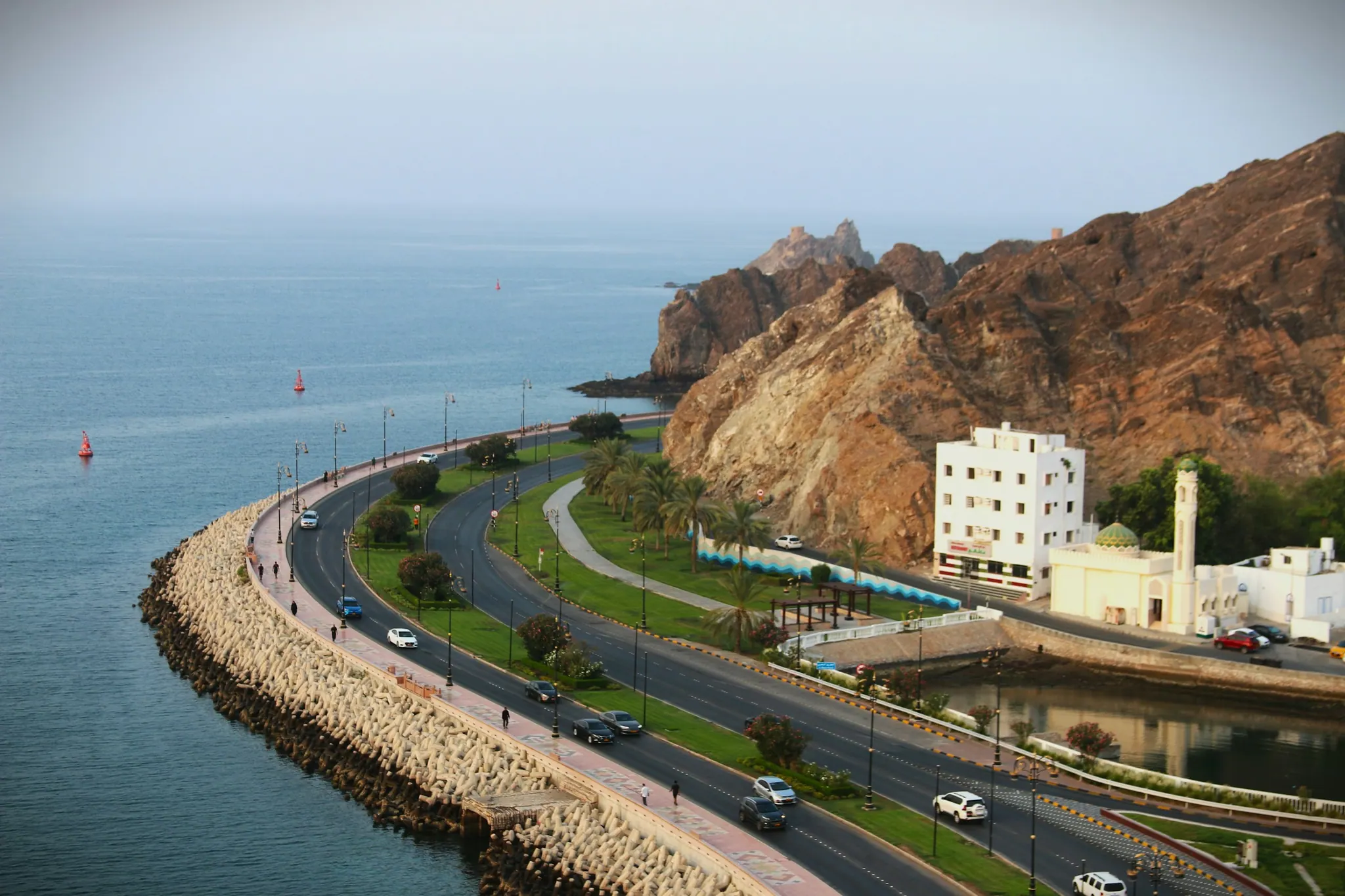
Oman is a driving country. Muscat grew along a narrow strip between the Hajar mountains and the sea, linked by expressways, and it has no metro, tram or suburban rail. Most households run at least one car, many two. Buses and taxis fill the gaps in the capital and in Salalah, and domestic flights link Muscat with Salalah and Duqm. Rail is coming, but to the north-west first: Hafeet Rail will link Sohar with the UAE, and the Muscat Metro is still a study.
For a buyer, that makes the drive from home to work, school and airport the most important number on any listing.
Driving in Muscat: drive times from our areas
Typical drive times to Muscat International Airport, outside the rush hours, from the areas we cover:
| Area | To Muscat International Airport, by car |
|---|---|
| Al Mouj | About 15 minutes |
| Madinat Al Irfan | About 20 minutes |
| Qurum, Shatti Al Qurum, Al Khuwair, Bausher, Ghala | About 25 minutes |
| Seeb | About 30 minutes |
| Muttrah | About 35 minutes |
| Sultan Haitham City | About 40 minutes |
| Barka | About 45 minutes |
| Muscat Bay, Bandar Jissah, AIDA | About 50 minutes |
| Jebel Sifah | About 85 minutes |
The city's spine runs east to west: the airport and Al Mouj sit to the west of the centre, the old town and Muttrah to the east, and the resort coast of Bandar Jissah, Muscat Bay, AIDA, Yiti and Jebel Sifah beyond them. Peak hours on the expressways add to every figure, so time the school run and the commute at 7 am before you buy.
Driving licences for visitors and residents
- Visitors may drive on a licence from their home country, or an international licence, for tourism or transit, for up to three months from entry, the Royal Oman Police (ROP) said in November 2024. International licences are issued in Oman by the Oman Automobile Association.
- Residents must hold an Omani driving licence. The minimum age is 18.
- Exchange or test. Not every foreign licence can be exchanged for an Omani one. Holders of licences from countries outside the exchange list take the Omani test. Ask the ROP for your country's status before you move, and keep your home licence valid in the meantime.
Car hire works on a visitor's licence; a resident buying a car registers it with the ROP and insures it before driving.
Petrol prices in Oman
| Fuel | Price a litre, end of October 2026 |
|---|---|
| M91 petrol | 229 baisa |
| M95 petrol | 239 baisa |
| Ultimax 98 | 399 baisa |
| Diesel | 258 baisa |
Prices are set monthly. In October 2026 Oman also applied a temporary 30-litre cap on refills at stations near border crossings. A family driving 250 litres of M91 a month spends about OMR 57; the cost of living guide puts it into a full budget.
Buses and taxis
Mwasalat, the national transport company, runs city buses in Muscat and Salalah and intercity coaches. Since February 2026 every Mwasalat bus has taken card payments, and from 1 August 2026 the Muscat and Salalah city services stopped accepting cash altogether. The city network serves the main roads and the airport rather than the gated communities, so for most residents the bus is a back-up rather than a daily option.
Taxis work across the capital. Agree the fare or use a metered or app-based service, and keep the receipt.
The Muscat Metro: still a study
The Ministry of Transport, Communications and Information Technology's plan for a Muscat Metro, about 50 km from Sultan Haitham City to Ruwi with around 36 stations, was still at the feasibility stage in January 2026. No tender or Cabinet approval had been reported after that. We advise buyers to choose a home that works by car, and to treat a future station nearby as a bonus rather than a reason to buy. Our journal follows the project in Hafeet Rail, the Muscat Metro and property.
Hafeet Rail: Oman to the UAE by train
Hafeet Rail is the joint Oman-UAE railway from Sohar to Abu Dhabi. The Ministry of Finance gives its length as 238 km, through Wadi Al Jizzi, Al Buraimi and Al Ain, and reported in April 2026 that it was 40% complete. No opening date has been given. Figures of 303 km still appear online; the ministry's 238 km is the one to use.
For property, the line matters most to Sohar and Al Buraimi, and to the UAE as a market for Omani homes: the Oman versus Dubai guide compares the two. Muscat is not on the route.
Airports and domestic flights
Muscat International Airport is the main gateway; Salalah International Airport serves Dhofar and fills in the Khareef season, when Dhofar received 251,064 visitors by air between 21 June and 31 August 2025. Duqm has its own airport. For Salalah buyers, the airport is about 15 minutes from the city by car, and the living in Salalah guide covers the rest.
Getting around Salalah
Salalah is smaller and easier. Salalah International Airport is about 15 minutes from the city by car, and Mwasalat runs city buses there on the same cashless system as Muscat. Hawana Salalah, Dhofar's Integrated Tourism Complex, sits on the coast outside the city: from Lubana Island it is about 20 minutes to the city and 30 to the airport. In the Khareef, when more than a million visitors arrive, most of them by road, the roads into the mountains slow at weekends and the airport fills, so owners who let their homes plan guest arrivals around it.
Choosing a home for the way you will travel
For a buyer, transport comes down to four questions. How long is the drive to work at 7 am? How long to the school? How far to the airport, if you fly often or let the home to visitors? And is there a supermarket and a clinic within ten minutes? A home that answers those well will be easier to live in and easier to let or sell. We drive each route with clients at the hour that matters before they reserve.
Driving to Oman from the UAE
Many buyers from the UAE drive. The border posts are open to private cars, and a UAE resident can enter on the GCC resident visa or a visa-free stay where their passport qualifies: the visiting Oman guide sets out the rules. Remember the temporary 30-litre fuel cap near border crossings, and that insurance from the UAE must cover Oman.
Practical points
- Emergencies: dial 9999 for police, ambulance and fire.
- Wadis: after heavy rain never drive into a flowing wadi; storms such as Cyclone Shaheen in 2021 showed how fast water rises.
- Time: Oman keeps Gulf Standard Time, UTC+4, with no daylight saving.
- Before you move: the moving checklist puts the licence, the car and insurance in order.